
Hive Wasp Attacks
Last autumn many beekeepers saw their strongest colonies overwhelmed by persistent wasp attacks. Even with good husbandry, reduced entrances and traps, some colonies simply couldn’t hold out. If wasps are becoming more persistent, we need to become more inventive.
Cost For Protection
The Hive Shield Entrance (HSE) design is for Abelo National poly hive bases, but with small adjustments it can be adapted to fit most hive types. Best of all, it’s inexpensive: one £5 length of electrical trunking makes five entrances, making it a practical option for beekeepers with multiple hives.
Why a shielded entrance works
Wasps are visual hunters. They follow scent and line‑of‑sight to the hive entrance, and once they find it, they return in numbers. The HSE disrupts this behaviour by creating a layered defence:
- A shielded front panel with a matrix of small holes that release hive scent to attract wasps but do not allow entry.
- Entry for the bees is via a left and a right side access tunnel.
- A row of 8 mm rear holes — true bee‑space — that bees can easily defend.
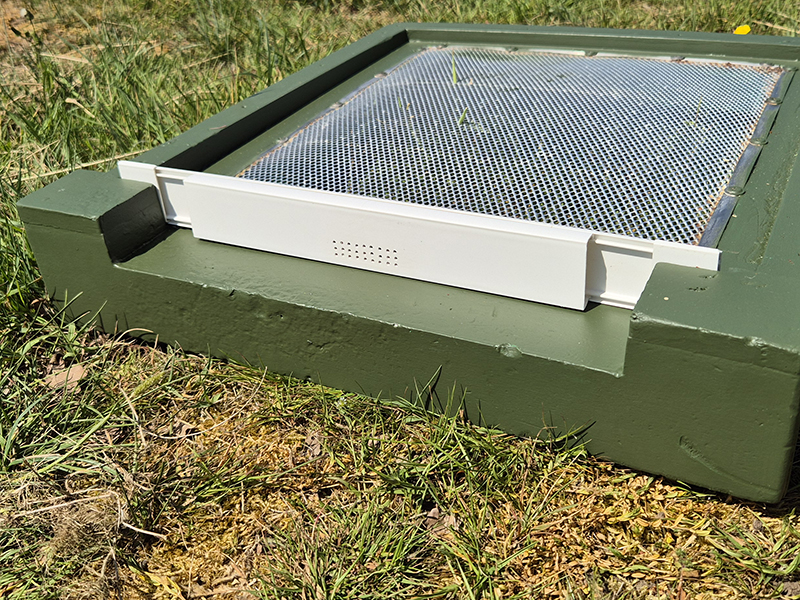
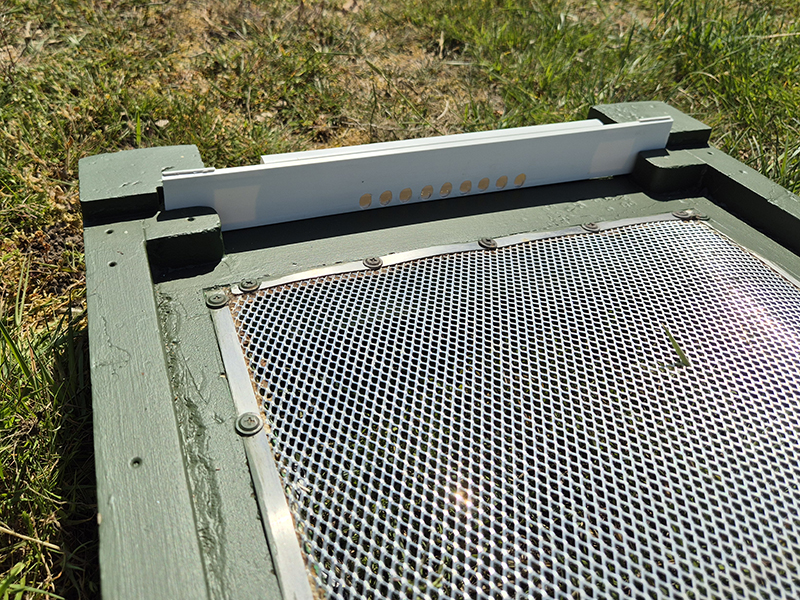
In practice, this means wasps spend time probing the wrong area while guard bees control two narrow, predictable access points. The design slows intruders, buys the colony time and channels all traffic through a defendable bottleneck.
When fitted the bees take around 10–15 minutes to reorientate. Within a day, they will use it confidently, and it will become noticeably calmer at the entrance.
Additional uses
The HSE can also function as:
- Entrance reducer — simply cover some rear holes.
- Entrance blocker — on Abelo hives, turning the HSE upside‑down seals the entrance completely.
- Mouse guard — the tunnel is too narrow for mice to enter.
Because the HSE is removable, it can be fitted seasonally — used during wasp pressure, robbing risk, or hornet activity, and removed when not needed.
Why this entrance matters
Wasp pressure appears to be increasing in many parts of the UK, and colonies weakened by poor forage, queen issues or late‑season stress are especially vulnerable. Traditional entrance reducers help, but they don’t confuse wasps — they simply narrow the target. The HSE adds an extra layer of misdirection and delay, giving bees the advantage.
For beekeepers using poly hives, where entrances are often wide and exposed, the HSE offers a practical way to improve defence without modifying the hive body. For wooden hives, the design can be adapted with a couple of screws.
At around £1 per hive, the HSE is a small investment that may prevent the loss of a colony and its winter stores.
Want to try it?
Download the pdf construction document here:
